

Custom hair ties have more commercial value when fashion brands develop them as part of a coordinated accessory collection rather than treating them as basic elastic products. Material, elastic structure, color, decorative details, intended use, packaging, and quality control all affect how well a hair tie fits the wider range.
For brands developing a new collection, the process should start with the product’s role and target customer before moving into materials and decoration. Everyday elastic hair ties may call for a clean, understated design, while scrunchies can introduce fabric texture and volume. Acetate-accented hair ties offer another option for brands that want distinctive color, pattern, or decorative detail.
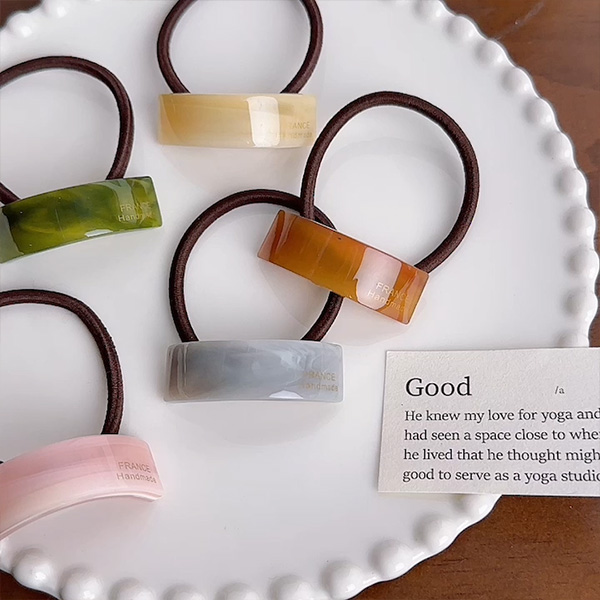
Dowell‘s current hair tie range includes lace pearl scrunchies, heart-shaped rhinestone acetate hair ties, retro minimalist elastic hair ties, and slim acetate-accented designs, giving fashion brands several starting points for collection development.
Start With the Role of Each Hair Tie
A balanced custom hair tie collection usually works better when each style has a clear purpose. Instead of developing several products that compete for the same role, brands can combine practical everyday pieces with softer fabric styles and more decorative designs.
Everyday Elastic Hair Ties
Everyday elastic hair ties should be easy to use and visually clean while still carrying enough design detail to feel distinctive to the brand.
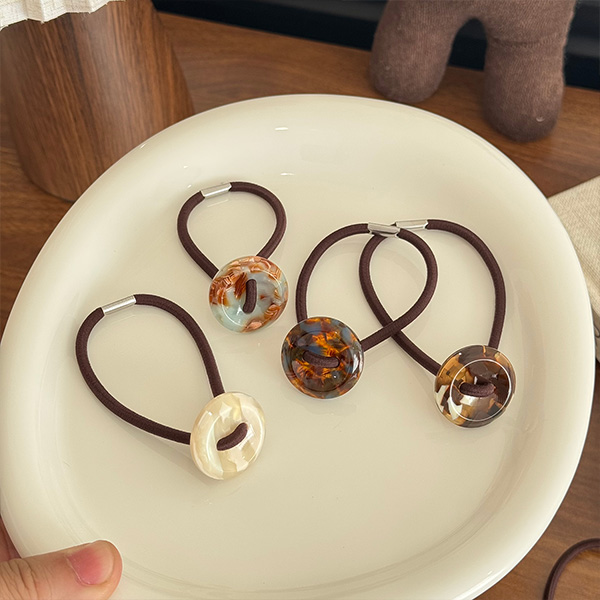
Simple acetate ornaments, coordinated elastic cords, compact shapes, and small metal details can add identity without making the product overly decorative. These styles work particularly well as core products that can remain in a collection across multiple seasons.
Dowell’s retro minimalist elastic hair tie, for example, combines a simple elastic cord with a circular acetate accent and a small metal detail. Its restrained construction makes it easier to coordinate with everyday and workwear-focused collections.
Scrunchies for Texture and Volume
Scrunchies add softness, fabric texture, and volume around a ponytail or bun. They also give brands more flexibility when developing romantic, occasion-focused, seasonal, or gift-ready collections.
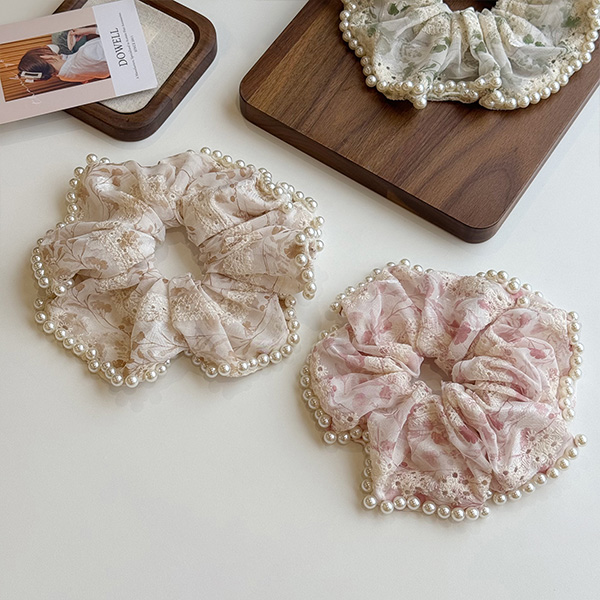
Fabric selection plays an important role in the finished look. Chiffon can create movement, lace adds surface detail, and pearls or other trims can make a style more decorative. Dowell’s Lace Pearl Scrunchie combines floral chiffon, lace, pearl trim, and an elastic band.
For a fashion brand developing a similar product, appearance is only one part of the decision. Fabric drape, seam quality, trim placement, pearl attachment, and elastic performance should also be considered before a design moves into production.
Acetate Hair Ties for a More Distinctive Finish
Acetate gives designers a compact surface for introducing pattern, gloss, color variation, and decorative shapes. Tortoiseshell, pearlescent, translucent, woven, and marble-like effects can make an acetate-accented hair tie visually more distinctive than a basic elastic.
The decorative shape can also be adapted to suit the wider collection. Minimal bars and circular ornaments fit understated ranges, while hearts, rhinestones, or more expressive forms can support romantic and seasonal styles.
Dowell’s heart-shaped rhinestone acetate hair tie combines an elastic cord with shaped acetate and rhinestone detailing, while its minimalist slim acetate design offers a cleaner option for everyday styling.
Key Customization Options for Custom Hair Ties
Once the role of the product has been defined, the next step is to turn the concept into specifications that a manufacturer can work with.
Size and elastic structure should be considered together. Brands need to think about how much stretch is required, how quickly the elastic should recover, which hairstyles the product is intended for, and whether the decorative component changes the weight or balance of the hair tie. A large acetate ornament, for example, may require a different cord or connection structure from a small everyday accent.
Material selection is equally important. Depending on the design, a custom hair tie may combine fabric, lace, pearls, rhinestones, acetate elements, metal components, and elastic cord. Dowell’s manufacturing information lists processes including printed patterns, sheet splicing, rhinestone and pearl inlay, metal accessory inlay, engraving, hand painting, and multi-layer bonding for suitable accessory designs.
These options should be selected according to the product rather than combined simply to make a design more complicated. A minimalist everyday hair tie may need only one well-finished acetate component, while an occasion-led scrunchie may depend more heavily on fabric, lace, and decorative trim.
Color and pattern also help connect hair ties with a wider fashion collection. Brands can work from seasonal palettes, Pantone references, apparel colors, jewelry finishes, or an established brand identity. With acetate, the material itself can become a major part of the visual design through tortoiseshell, translucent, gradient, pearlescent, or mixed-color effects.
Branding can then be incorporated according to the structure of the product. Dowell describes several logo techniques, including engraving, silk-screen printing, pad printing, hot stamping, UV printing, and metal logo elements.
Packaging should also be considered during development rather than left until bulk production is nearly complete. A simple everyday elastic may require only a branded display card, while a scrunchie set or seasonal collection may be more suitable for a multi-piece card, gift box, hang tag, or other retail presentation.
Sampling and Wear Testing Before Bulk Production
Sampling is one of the most important stages in custom hair tie development because it turns a visual concept into a physical product that can be tested.
Dowell’s offers a process in which customers provide design drawings or reference samples, the design team evaluates the requirements, and material preparation or mold development is arranged before manual assembly, polishing, physical sample confirmation, and bulk production.
A sample review should go beyond asking whether the product looks attractive. Brands should stretch the hair tie repeatedly to see whether the elastic returns to its intended size and test it in the hairstyles for which it was designed. They should also check whether the cord, connector, seams, or decorative components catch on the hair during removal.
Decorative security is another important point. Pearls, rhinestones, acetate elements, and metal details should remain stable during normal handling. Visible glue, uneven seams, scratches, burrs, rough edges, or inconsistent polishing should also be identified before the sample is approved.
Color and proportions should be checked against the original design brief. The physical sample should be compared with approved color references under appropriate lighting, while the size and weight of decorative components should be assessed in relation to the elastic structure.
Branding and packaging should be reviewed at the same stage whenever possible. Logo placement, printing quality, hang tags, retail cards, package dimensions, and barcode positions are easier to correct during sampling than after bulk production has already started.
Quality Control for Custom Hair Ties
Once the final sample has been approved, it should become the reference standard for bulk production.
For custom hair ties, quality control should focus on the factors that directly affect appearance and use. Finished dimensions should remain within the agreed tolerance, elastic performance should be consistent, and cord connections should be secure. Stitching, seams, acetate surfaces, decorative attachments, colors, patterns, logo placement, and packaging should also be checked against the approved sample.
MOQ and Production Planning
MOQ can influence how many colors, designs, and SKUs a brand is able to launch at one time, so it should be discussed early in the development process.
Dowell indicates that some light-customization projects based on existing styles can start from around 120 pieces, while deeper customization, exclusive colors, special materials, or new tooling may require higher quantities. Exact MOQ therefore needs to be confirmed for each project rather than applied to every hair tie design.
How Dowell Supports Custom Hair Tie Development
Dowell focuses on acetate, acrylic, and related hair and fashion accessories. Its product categories include hair clips, hair bands, combs, hair ties, and other accessories.
For customization projects, Dowell supports bulk and small-batch orders, sampling, pre-production samples, pattern and color customization, decorative processes, logo applications, and packaging development.
Conclusion
Developing custom hair ties involves more than choosing an attractive color or decorative shape. A commercially useful product needs a clear role within the collection, an appropriate elastic structure, suitable materials, reliable decoration, consistent finishing, practical packaging, and quality standards that can be reproduced during bulk production.
Dowell’s range of elastic hair ties, scrunchies, and acetate-accented designs provides several starting points for collection development, while its customization capabilities cover design evaluation, sampling, materials and decorative processes, production, inspection, and packaging.
Contact us to discuss your design ideas, materials, customization options, sampling, and production requirements.
FAQ
Q: What can fashion brands customize on hair ties?
A: Depending on the product structure, customization can cover size, color, elastic components, acetate patterns, fabrics, decorative elements, logos, and packaging. Brands should first define the overall design and intended use, then confirm with the manufacturer which customization options are suitable for that specific construction.
Q: How should a custom hair tie be tested before bulk production?
A: A sample should be tested for stretch and recovery, practical hold, ease of removal, component attachment, stitching, edge finish, dimensions, color consistency, branding, and packaging. The test should reflect the hairstyles and wearing conditions for which the product was designed rather than relying only on its appearance.
Q: Are acetate hair ties suitable for premium accessory collections?
A: Acetate-accented hair ties can work well in premium collections because the material allows for distinctive color, pattern, gloss, and decorative forms. Premium positioning, however, also depends on polishing, edge finish, attachment quality, elastic performance, branding, and packaging rather than on the material alone.


