

The best flower claw clips balance a distinctive floral silhouette with comfortable grip, smooth edges, and proportions suited to the intended hairstyle. Material, tooth geometry, spring action, and overall weight matter as much as color or petal shape. When these elements work together, the clip becomes an easy everyday accessory rather than a purely decorative piece.
Flower-shaped accessories continue to appear across contemporary hair styling because they make a simple twist or half-up look feel considered in seconds. Their appeal comes from this contrast: the design looks expressive, yet the familiar claw mechanism remains quick and practical. Dowell develops floral forms within a wider collection of acetate and acrylic hair accessories.
Why Flower Claw Clips Remain Relevant
A Strong Shape with Everyday Function
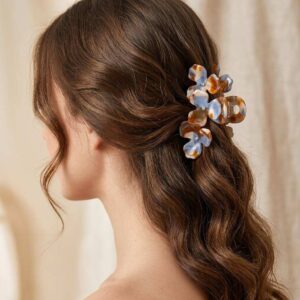
A flower outline creates an immediate focal point without demanding an elaborate hairstyle. Depending on its scale, a flower claw can hold a side section, support a half-up style, or anchor a relaxed twist. The petals soften the mechanical appearance of the clip while the teeth and spring perform the practical work.
Comfort depends on how closely the clip matches the hair it is meant to hold. Fine or short hair often benefits from a lighter body and closer tooth spacing, while thick or long hair may need deeper teeth, a wider opening, and more secure tension. A balanced clip should feel stable without pulling at the scalp or creating pressure at one point.
From Accent Piece to Coordinated Collection
Floral clips work well as a family of related shapes rather than a single statement design. Mini, medium, and larger versions can repeat the same petal language while serving different hair lengths and styling habits. Neutral tortoiseshell, ivory, amber, and translucent tones give the motif a seasonless quality, while brighter colors introduce a more playful mood.
How Material Shapes Flower Claw Clips
Cellulose Acetate and Visual Depth
Dowell focuses on acetate and acrylic accessories. Cellulose acetate is especially expressive in layered color, translucent effects, and tortoiseshell patterns. Light can move through the material in a way that adds depth to broad petals and curved surfaces. The finished character, however, also depends on accurate cutting, careful polishing, clean assembly, and thoughtful placement of the pattern.
Acrylic and a Clearer Graphic Effect
Acrylic can give flower claw clips a crisp, graphic appearance, particularly in solid or highly defined colors. Its visual directness suits modern floral shapes with clean outlines and simplified petals. Material choice should follow the intended mood: acetate often feels layered and organic, while acrylic can appear brighter, sharper, and more contemporary.
Design Details That Influence the Final Look
Scale, Petal Proportion, and Hair Capacity
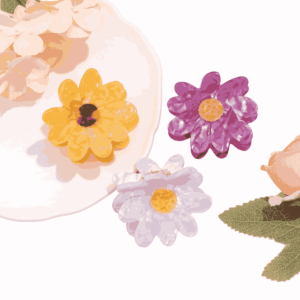
Scale changes both the styling effect and the amount of hair a clip can manage. Dowell has listed a 6.5 cm flower hair accessory, which illustrates a compact floral format rather than a universal size standard. Smaller forms can act as subtle accents, while larger flowers become the central feature of an updo.
Petal width, body curvature, tooth length, and opening distance should read as one coherent design. Broad petals create a softer silhouette, whereas narrow or pointed petals feel more graphic. The mechanism should remain visually integrated, with the hinge and spring positioned so they do not overwhelm the flower when viewed from the side.
Color, Pattern, and Surface Finish
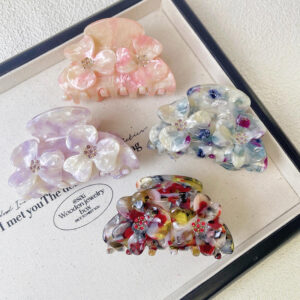
Translucent color can make a flower clip feel light and luminous, while opaque material gives the shape more visual weight. Tortoiseshell and marbled patterns add movement, although each cut section may show a different distribution of color. That natural variation is part of the appeal of patterned sheet material and can make individual pieces feel less uniform.
Surface finish determines how refined the design feels in the hand and in close-up photography. Petal transitions, outer edges, tooth tips, and the area around the hinge should all feel smooth. Because a flower repeats similar curves around its perimeter, uneven polishing or asymmetry is often more noticeable than it would be on a simple rectangular clip.
What Defines a Well-Made Flower Claw Clip
Grip, Alignment, and Spring Action
A well-made clip opens smoothly and closes with even alignment across both rows of teeth. The spring should provide enough resistance to hold the intended hairstyle without making the clip awkward to use. Teeth that meet unevenly can reduce stability, while overly sharp tips or rough inner edges can catch hair.
The relationship between weight and tension is equally important. A large floral body may look dramatic, but it should not feel top-heavy once worn. Testing the clip in a half-up style, low twist, and relaxed bun reveals more about its everyday performance than judging the accessory only while it is displayed flat.
Symmetry, Assembly, and Finishing
Repeated petals make symmetry a defining quality cue. Slight organic variation can suit a hand-drawn floral concept, but unintended differences in petal length, spacing, or curvature tend to appear as production inconsistencies. The two halves should also meet cleanly when closed, without visible twisting around the hinge.
Decorative stones, metal accents, or layered elements introduce additional points of attention. Their placement should support the center of the flower rather than distract from the silhouette. Clean attachment, minimal residue, consistent spacing, and a smooth reverse side help the embellishment feel integrated into the accessory.
How Dowell Develops Custom Hair Accessories
From Visual Reference to Finished Design
Dowell’s OEM/ODM customization process begins with a reference image or written description covering clip type, material thickness, color, and pattern. The concept then moves through detail confirmation, design and sample preparation, sample approval, production, quality inspection, and completion. The sequence shows how an initial visual idea is translated into a repeatable accessory.
Clear creative direction improves the design process. Good references should identify the intended hairstyle, overall scale, petal character, material effect, seasonal color direction, surface finish, and any decorative element. Reviewing the object from the front, side, and open position helps ensure that the floral idea remains convincing around the working mechanism.
Creating a Consistent Hair Accessory Story
Dowell’s acetate and acrylic focus allows flower claw clips to sit naturally beside barrettes, simple claws, and other coordinated hair accessories. A consistent material or color story can connect these different forms without making every piece identical. More detailed floral clips work best as visual anchors, supported by quieter shapes in related tones.
Conclusion
Flower claw clips endure because they combine an expressive motif with a familiar, useful mechanism. Their quality is shaped by more than the flower outline: material depth, balanced proportions, smooth finishing, reliable grip, and thoughtful assembly all influence how the accessory looks and feels. Through careful development, Dowell can translate floral inspiration into cohesive hair accessories designed for real everyday styling.
Contact us to discuss a custom flower claw clip concept with Dowell.
FAQ
Q: What makes flower claw clips comfortable to wear?
A: Comfort comes from a balanced combination of weight, tooth spacing, opening width, and spring tension. A clip should hold the intended hairstyle without pulling, pinching, or concentrating pressure in one area. Smooth tooth tips and polished inner edges also reduce snagging, especially when the clip is removed after several hours.
Q: Can Dowell customize colors, patterns, and logos?
A: Dowell’s OEM/ODM process accepts reference images or written descriptions covering clip type, material thickness, color, and pattern. Personalized details can include logos and color blocking. The most coherent results begin with a focused creative brief that connects the floral shape, material effect, finish, and visual identity.
Q: Is acetate suitable for patterned flower claw clips?
A: Cellulose acetate is well suited to layered colors, translucent effects, marbling, and tortoiseshell patterns. Because the design is cut from patterned board, color placement may vary naturally from one piece to another. Careful cutting and polishing help each variation retain a clean flower silhouette and a smooth surface.
Q: How can flower claw clips be styled for different hair lengths?
A: Smaller floral clips can secure side sections, bangs, or a light half-up style, while medium clips work well for partial twists. Larger designs can anchor a relaxed bun or full twist when their teeth and opening suit the hair volume. The most secure result comes from matching clip capacity to the hairstyle.


